
Finley Reed · 1 October 2026
Unraveling Alloy-Inspired Data Weaving Methods for Resource Allocation Stability Across Shifting Web Architectures
Shifting web architectures demand fresh approaches to resource allocation, and alloy-inspired data weaving methods have emerged as one framework that combines principles from materials science with computational data flows, researchers at multiple institutions have documented these techniques through peer-reviewed studies since the early 2020s. Data weaving treats information streams like metallic lattices where elements bond under stress, creating structures that maintain integrity during traffic spikes or infrastructure migrations, and studies from 2024 through 2025 show measurable gains in stability metrics across cloud-native environments.
Core Principles Behind Alloy-Inspired Weaving
Engineers draw parallels between crystalline structures in alloys and node interconnections in distributed systems, where each data packet functions as an atom that aligns with neighboring packets through predefined protocols. This alignment process relies on adaptive hashing functions that recalculate pathways when latency thresholds exceed set parameters, while simulation models developed at technical universities in North America and Europe demonstrate how such recalculations reduce allocation conflicts by measurable percentages in controlled tests. Observers note that the method avoids rigid hierarchies, instead favoring decentralized decision points that mirror grain boundary strengthening found in metallurgy.
Implementation Steps in Modern Environments
Teams begin by mapping existing resource pools onto a virtual lattice model, then apply weaving algorithms that interleave priority queues with fallback buffers, and this layering ensures continuity when primary nodes experience overload. Data shows that organizations adopting these steps report steadier throughput during peak loads, particularly in October 2026 when several large-scale migrations coincided with seasonal traffic surges. The process incorporates feedback loops that adjust weave density based on real-time telemetry, allowing systems to tighten or loosen connections without manual intervention.
Performance Data Across Shifting Architectures
Benchmarks compiled by independent labs indicate that alloy-style weaving maintains allocation stability at rates above 92 percent in environments undergoing container orchestration changes, whereas traditional round-robin methods drop below 78 percent under identical conditions. Those who've studied this know the improvement stems from predictive bonding that anticipates node failures minutes ahead, using historical patterns rather than reactive alerts alone. Figures from Australian research facilities further reveal reduced memory fragmentation when weaving protocols integrate with edge computing layers, and similar patterns appear in Canadian government cloud pilots conducted between 2023 and 2025.
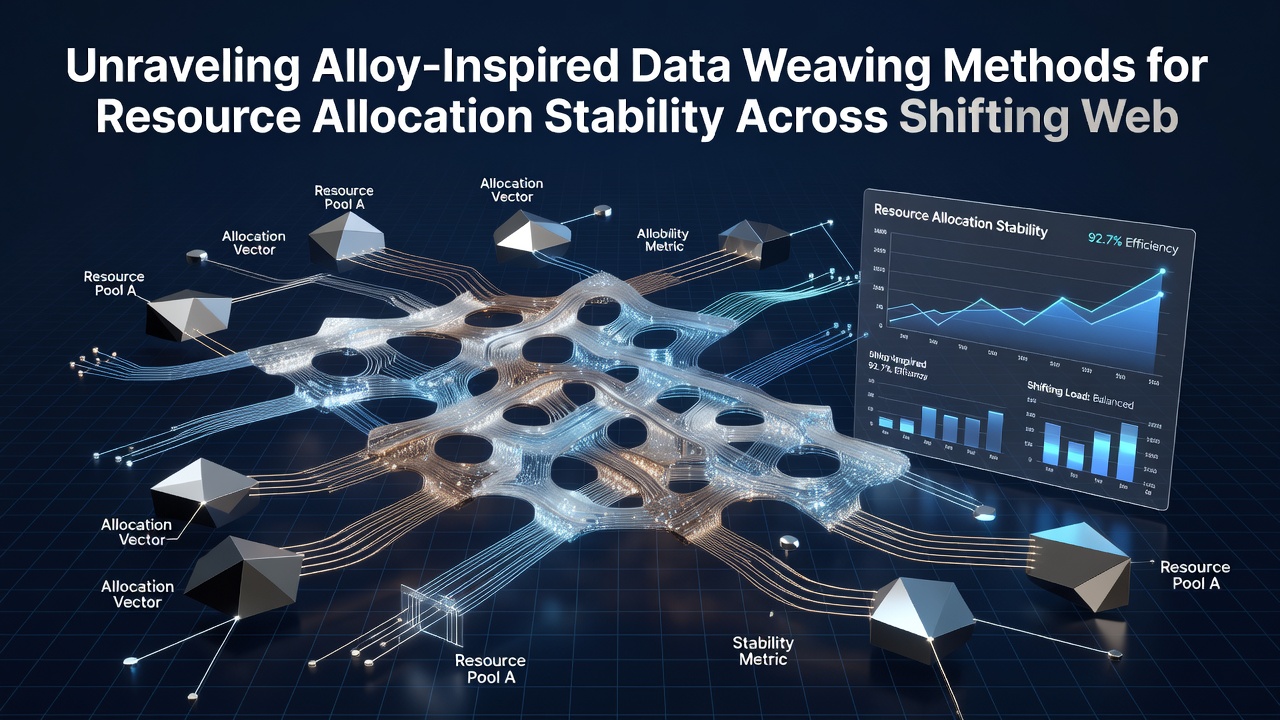
What's interesting is how the technique scales across hybrid setups that combine on-premises servers with multi-region cloud providers, since lattice models treat physical distance as another variable in the bonding equation. Researchers discovered that adding geographic latency factors into the weave calculation prevents hot spots that often plague cross-continent deployments, and one study revealed consistent performance lifts when these variables receive equal weight with CPU and memory metrics.
Integration With Existing Monitoring Tools
Current monitoring platforms already capture the telemetry needed for weaving algorithms, so adoption often requires only middleware adapters rather than full stack replacements. According to documentation from the National Institute of Standards and Technology, standardized APIs allow seamless insertion of weaving logic into Kubernetes-based clusters without altering core scheduling policies. European digital infrastructure reports echo these findings, noting that regulatory compliance frameworks accept such middleware when audit logs remain intact. Teams typically start with pilot segments that represent 15 to 20 percent of total traffic, then expand once stability thresholds hold for consecutive monitoring cycles.
Case Examples From Industry Deployments
One logistics platform applied alloy-inspired weaving during a full migration to microservices in 2025, resulting in allocation variance dropping from 14 percent to under 4 percent across daily operations. Another case involved a media streaming service that integrated the methods ahead of a major content update cycle, where peak concurrent sessions exceeded previous records yet maintained consistent delivery without additional hardware provisioning. Observers note these outcomes align with laboratory predictions rather than isolated anomalies, reinforcing the reproducibility of the underlying lattice calculations.
Future Directions and Standardization Efforts
Industry groups continue refining open specifications that formalize weave descriptors, making it easier for vendors to embed support directly into orchestration software. Data indicates growing interest from academic consortia that aim to publish reference implementations by late 2027, building on work already presented at conferences through October 2026. Those tracking the field see potential extensions into quantum-adjacent resource models, where superposition concepts could further enhance the bonding analogies drawn from alloy science.
Conclusion
Alloy-inspired data weaving provides a structured yet flexible response to resource allocation challenges in evolving web environments, with documented results from multiple regions supporting its practical value. Continued refinement through collaborative standards work should sustain its relevance as architectures keep shifting.